Monday, December 08, 2008

Take me out to the ball game

Take me out to the ball game, take me out with the crowd :)
On Saturday I went to a basketball game in Chicago. Our team, the Fighting Illini, were playing against the University of Georgia team, the Georgia Bulldogs.

So here are some pictures! The Fighting Illini colours are bright orange and navy, and Georgia is navy and red. My camera doesn't like movement so some pics sre blurry.

I will provide some commentary so you can learn from my American cultural experience.

This is just to illustrate the dedication of the fans - all decked out in Illini orange!

And this to illustrate the size of the stadium. That big square of TV panels at the top shows close ups and replays and game stats during the game.

And between the levels of people are more LDC panels that show team logos during the match, and psychadelic light show colours at opportune times too. Like before the match when the lights go off and the players huddle and the spotlight fall on them and the do a bit of a phyching themselves up go team thing. And the players are announced by name, and they run on to the court.

On that note - the match commentary is pretty funny. And mostly consists of a WWF style voice going "Miiiiiiiiiike Davis for three points!" whenever Mike Davis shoots a three point shot.* :)

The guys on the floor during the above picture were a local is lekker dance group doing some halftime entertainment. What is that dance style where people spend a lot of time spinning on their heads? Yeah, it was that.

This picture is here for two reasons. First, see the huddle of men in suits and men in orange in the top corner? That is the basketball team with the suited people I assume to be their coaches. These huddles happen during time outs, which are approximately every 1 to 2 minutes. I'm not kidding. These college basketball matches are 20 minutes per side, but the whole game takes about two hours (including a 15 minute half time). Because there are 30 second or minute long time outs every minute or two.

What happens during time outs? The answer: all sorts of theatrics! That is the second part of this picture. The girls you see are the pep squad. They do some dancing to music. They are not to be confused with the cheer leaders, pictured below.

The cheer leaders are more like gymnasts than anything else. Or maybe circus acrobats. They are amazing. They do all sorts of death defying feats, one of which is pictured above. And they stay standing up like that for ages. Wow.

And this is the band. They play before the match and in time outs sometimes and during halftime. And they don't just play, they dance. Awesome.

But the main attraction is not the band or the pep squad or the cheerleaders. It's the ballgame:

We won the men's game against Georgia. But sadly lost the woman's game against Bradley (our ladies were wearing white):


I am also pleased to announce that I could follow the match. I sort of understand basketball now. As indicated by the asterisk (*) above, I know the difference between a two point shot and a three point shot. I understand what plays are about. I sortof understand the walking issue. I don't really understand fouls though.

But I know enough to be able to clap at the right time and gasp at the right time, and thats the most important thing!

Bringing back the draft

A few days ago Tash asked me what I thought about bringing back the draft. So I thought about it, and here is my 0.5 cents:

It seems to me that there are two benefits of compulsory conscription:

1) A few months ago I read about some political someone or other suggesting that we bring back the draft. And if I remember correctly, her reasoning was to do with so many young people being unemployed. So conscription was viewed as a way to help get these kids on their feet, in some sort of employ. And also give them some skills and teach them some discipline.

2) It is a good thing for a country to have a populace who is able to defend themselves. In the form of an army, protection external attack. And also just having citizens who are able to defend themselves from crime and potentially the government, if the government ever goes haywire.

I'm out of the loop of what is going on in SA at the moment, so maybe those are not quite the reasons people are giving to bring back the draft. If not, please enlighten me - what are they?

When I first read about the suggestion of bringing back the draft I didn't think it was too bad an idea. Then when Tash asked me I gave it some more thought. And now I'm not for it.

Why? Well, looking at the two benefits the draft could possibly give us (starting with 2):

2) Having a ready army and citizens who are ready to defend themselves is good, yes. But I think this needs to be balanced with the fact that although I am really not worried about the future of SA, we are still not 100% politically stable. So the idea of us having a massive army makes me feel more nervous than secure. Just in case the day does come when our government decides to use the army against the population. Also, in a country where we see so much violent crime already... I'm not excited about training young people to use weapons.

1) Okay, this is the more interesting one for me. Because the problem with youth unemployment really weighs on me and I support efforts to do something about it. And I can see some benefit in doing it through the army. That is is a good environment for young people to learn to be disciplined, to maybe find some direction and to open some doors for them. And the military does already have some infrastructure for this, for training young people. So in that respect I think the draft has some merit.

BUT I don't think it is the best way to do this. If the government are going to spend an enormous amount of money on this, with one of the main goals being to help young people, then I think this money could be better used in another way.

I once read about Khama III, king of the Bamangwato people in Botswana around 1900. They used to have an initiation ritual for young men which included circumcision. Khama got rid of the ritual itself, but instead used the groups of young men who would be going off for this manhood ritual as work groups. So he effectively changed the ritual into a six month stint of community service, where young men would go and build hospitals, schools, infrastructure. I don't know if they still have that tradition today. But I think what he did was great, taking a tradition they had and turning it into something that really benefited their communities.

Anyway, along those lines: would it not be better to use school leavers for some sort of community service? Some sort of public works programme? Much better than conscription, I think, because it actually results in infrastructure development. And also because I think something like that has the potential to equip young people for the working world better than time in the army. It wouldn't only have to be public works, perhaps it could be extended to helping in other areas of government service, or even have an option of working in NGOs.

The problem with this is that it would be an epic thing to organise. If the government can't even sort out their own Home Affairs department, or the schools, how do they think they will be able to organise something like this? Which is a benefit of the army - they already have some capacity to do this. It would need to be expanded, but they already have the framework.

I read a while back about the army being used to build RDP houses in the Eastern Cape. Which I thought was rather good. So perhaps the military could be used as a structure through which a year or six months of community service could be facilitated.

But on the whole, I would prefer not to use the military!

Okay, those are my 0.5 cents!
Any thoughts anyone?

Friday, December 05, 2008

Compatriots

South African politics at the moment is more exciting than a good Isidingo story line (which were far and few between when last I was watching Isidingo, incidentally. Maybe that is why the nation has turned to politics for some excitement).

I really don't know how well COPE is going to do. I'm waiting to see what their policy documents say, for one. That must be one major job, putting together their policy. Because as much as they protest, they are really just a group of people united by their desire NOT to be the ANC.

But in spite of that, I think COPE is an organisation whose time has come. Khaya recently wrote about COPE being a response to the "fierce urgency of now." Exactly. Exactly exactly.

In ancient Greek there were two words for time. Chronos time is the ordinary sequential step by step time. And then there was Kairos time. Kairos time is a time in between, a moment of undetermined period of time in which something special happens (wikipedia). Kairos time is the time of opportunity. It has the connotation of being a time of crisis, where things can change dramatically.

As Galadriel said in Lord of the Rings, "The quest balances on the edge of a knife."

What Lekota and Shilowa and COPE have done is to recognise the kairos moment South Africa is in. A few years ago the announcement of an ANC breakaway party would have fallen completely flat. Today COPE is riding on the urgency of now, on the frustration of masses of people in our country.

Me, I haven't decided who will get my vote yet. I have toyed with the idea of joining COPE, just because I want to be part of moving our nation forward. But I haven't decided yet if the best way to do that is through COPE. We will see.

I once took note of Thabo Mbeki adressing a speech to "compatriots." I noted it because it was different to the usual struggle veteran, "comrades." And because I liked it. Compatriots - fellow patriots. Nice. Comrade is word that only includes people with a certain mindset, and a certain history. And for the people with that mindset and history, that is great. But that is not all of us. Compatriot. Fellow patriot. That is all of us.

I read on the Friends of Democracy webpage comments, someone suggest we change our language to move from "comrades" to "compatriots". Which I thought was excellent. And very discerning.

So yes, to my fellow patriots!

Thursday, December 04, 2008

Americans

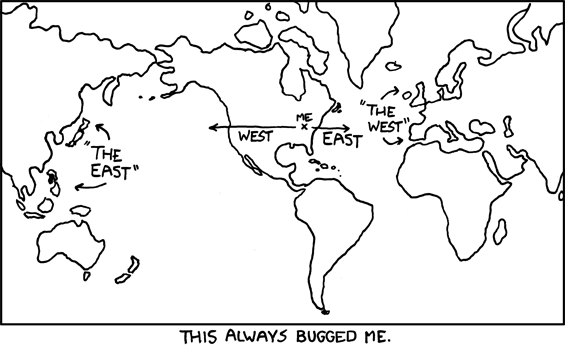
From XKCD:


Yes Americans, any view of the world where you are not in the centre... gosh it just doesn't make sense!

;)

Wednesday, December 03, 2008

Come now

The ANC saying it will rule till Jesus returns? that was pretty dumb. Arrogant. But not blasphemous. I don't think so anyway.

I watched a Journeyman Pictures documentary about Zuma a week or so ago. They interviewed, among others, some people from his home area. And one of them claimed that the Devil was behind all of JZ's probems.

A couple of days ago Ace Magashule, leader of the Free State ANC, claimed that JZ has been suffering in a similar way to Jesus: persecuted, insulted, betrayed (IOL article here).

The ID and the ACDP have taken exception to this, the Magashule comment in particular (here and here).

I'm a Christian, but I don't think any of the above comments were blasphemous. Do you?

I do think then can be manipulative. Definately. A large number of South Africans are Christians, so Biblical methaphor is meaningful to them. And using Biblical metaphor gives the speaker (and organisation!) an air of righteousness. He is using the Bible in his speech, it must be Godly. That sort of thing. People may not think it out exactly like that, but that is what they can come away with. Our great leaders, ordained by God, untouchable.

So yes, I think it can be manipulative. But not blasphemous.

When people made a fuss about it, Magashule responded that he was a Christian and that he wasn't comparing Zuma to Jesus, just the circumstance Zuma is in. Which I think is completely reasonable.

If anything, I think the man who blamed Zuma's troubles on the Devil was a bit more worrying. Especially because his next comments were "the strength of the Zulu nation is being tested through him" and "he was born to lead."

Goodness. I wonder if lots of people think that?

Friday, November 28, 2008

Winter Soldier


Apologies all, for not blogging very regularly!

A few posts ago I mentioned that I was heading to an event called "Winter Soldier" orgainsed by the Iraq Veterans Against the War. I didn't really know what I was in for: someone handed me a flyer for it, I thought it sounded interesting, so I went.

The term Winter Soldier comes from a 1776 quote by Thomas Paine:
"These are the times that try men's souls: The summer soldier and the sunshine patriot will, in this crisis, shrink from the service of their country; but he that stands it now, deserves the love and thanks of man and woman."

The pamphlet describes the event as "True stories from the men and women who fought the "war on terrorism."" Apparently Winter Soldier events were started after the Vietnam war, organised by the Vietnam Veterans Against the War.

A panel of soldiers sit in front of an audience, and tell stories about why they are against the war. Some of the stories are harrowing: killing of civilians, racism, brutality, graphic accounts of violent deaths. Some are less so: complaints about problems with war veterans medical aid, complaints about military culture, complaints about army recruitment methods and how and when reserves are called up.

War is a horrible thing. And there is an special horror to a war like this: fought in urban areas, populated by ordinary citizens. Where the people who are tying to kill you look just like the people you are trying to protect. Where the cars that explode to kill Iraqi civillians and American soldiers look just like the cars that little old ladies drive to town. Where the trucks that terrorists drive look just like the trucks that farmers use to drive their produce to market.

The testifying soldiers were mostly young men, trained to fight, trained to kill. In an environment where every day their lives were in danger from an enemy that was everywhere and nowhere at the same time. With few clear goals beyond getting back home alive. And with ever-relaxing rules of engagement. Witnessing so much death. Of Iraqi people and of their fellow soldiers.

So at Winter Soldier some of these guys testify to torturing people, killing civillians needlessly, wrecking people's homes. Battle their way through stories of watching people die. Speaking about the fashbacks they still have.

I thought about the event for a bit afterwards. I think that one thing we have to remember is that they are part of an anti-war organisation, so the events are co-ordinated and the speakers speak with that agenda. I am definately not pro-war, that is not what I am saying. But I think it means that it gives a bit of a skewed picture of the war as only being about racist young men brutalizing innocent Iraqi citizens. Which is no more true than the pro-war spin that has honourable young soldiers protecting the poor Iraqi victims from the evil terrorists and playing soccer with grateful Iraqi children.

The truth, I think, is somewhere in the middle. But one thing an event like this definately shows us is that people just like us can do terrible things. People just like us can torture people, can kill innocent people, can become numb to what they are doing. These guys and girls who testified, they were young people. Just ordinary young people. Most joined the military because they thought they could do some good in the world. Makes you think...

Thursday, November 20, 2008

House cleaning

I'm doing some blog house keeping - taking down links to blogs that haven't been updated in an age.

These are the ones I am taking down:

Sorry to my friends who are being axed! I axe you reluctantly, only because you have not blogged in ages!

Communist University was a very interesting blog, pity it seems to be inactive.

Wednesday, November 19, 2008

Swinging like its 1945


I was in the middle of a blog post about the Iraq was and the Winter Soldier campaign when I had to leave it to go to my East Coast Swing dance class.

And it was too much fun not to write about - so for now, the Iraq was post is postponed. Watch this space!

East Coast Swing is a dance style with similar moves to the jitterbug and the jive. It's one one the swing styles danced in the USA in the 20's through 40's. Jazzy, lots of turning, bouncy. But the East Coast Swing is a bit more laid back than the serious serious Lindy Hop high speed stuff.

And I've just taken my 4th class! And who would have guessed, but it is an EPIC amount of fun. I am not sporty AT ALL, and I really can't dance (at weddings I'm the one sitting at the table hoping it will all end soon!).
But this, this is something else! It is *SO* much fun.

We have also been learning the basic Charleston and next week we are going to learn some moves to jazz the Charleston up.

I never ever thought I would enjoy it so much, I went reluctantly thinking it would be something interesting to do. And I'm loving it :)

So yes, I say to you all - if you get the chance, learn to swing! I'm going to need people to dance with when I am back home in SA!
And just in case you think its not African enough for you, I just tried the Charleston to Johnny Clegg's "Cruel, Crazy And Beautiful World." Brilliant!
Yup, Jika Majika, here I come!
Or maybe, better, "So you think you can dance?" ;)

Thursday, November 13, 2008

Checking in

I haven't posted much here for a couple of weeks because I've been trying to be a hard working student. Also because I've been blogging on ONCtoday every now and then, and in studious mode I can't justify the time spent doing two sets of blog entries!

I'm waiting for my computer to run a task right now, so here I am, checking into my blog.

I'm going to a "Winter Soldier" talk tonight, where Iraq war vets telling their stories. Its funny how the term "war veterans" has a completely different connotation in America than in South Africa. In the US war vets are heros. On Tuesday it was Veteran's Day in the USA - a public holiday with children going to perform music concerts for war vets and "Thank you to our veterans" signs on the busses.

Anyway, this talk tonight is organised by a group called "Iraq Veterans Against the War," so it should be interesting.

I'm just finishing off reading "In a Differrent Time" by Peter Harris and I think it may be turning me into a pacifist. I went through a stage of "THE TRC?!?! WHAT WERE WE THINKING?? THESE PEOPLE SHOULD BE IN JAIL!!!!! AT LEAST!!" But then I contemplated it some more... I was a bit distubed by my desire for vengence! It made me realise how wicked my own heart could be! Which moved me to the other side... I'n not really sure what I think of all of this now, but I'm leaning towards pacifism :)

Thursday, November 06, 2008

US elections


I went down to the polls yesterday, to check out some American's voting. There was nothing much to see really. Except a local state candidate handing out flyers (Frank Calabrese - Fresh face, fresh ideas for Illinois!).

And Lincoln, in the picture above, doing his bit for Obama. I chatted to him a bit about why Lincoln would have voted for Obama.

The political campaigns in the the US are amazing. The campaigns have databases of... everyone. They go door to door in the year or so before exams, thousands and thousands of volunteers from around the country. The College Democrats at the University of Illinois (where I am at the moment) have spent Saturdays this whole year driving hours to a neibouring state to go knock on doors and chat to people about voting for Obama. They are sent out with information of who is living at different houses, and their political leanings. And they specifically target swing voters - people who aren't strongly Democrat or Republican already.

Imagine that.

I went to a talk by Naomi Klein the other day and she said that in the USA they spend to such tme and energy on elections that there is hardly any time for politics.

Sunday, October 26, 2008

Pay for Peace


The city of New York is running what they call the "Pay for Peace Gun Buy Back programme". Their aim is to get guns off the streets, so they offer $200 in exchange for guns, no questions asked.

People can hand in their guns for $100 at police stations any time, but this buy back programme is being run through churches. Pastors claim that people are a lot more likely to hand in a gun at a church than a police station. Which makes sense - I'm sure people involved in criminal activities don't want to go anywhere near a police station.

"Drop off your gun in exchange for a $200 bank card Saturday from 11a.m. to 5 p.m. at: Sts. Peter and Paul Church, 71 S. Third St.; All Saints Church, 115 Throop Ave., St. Barbara Church, 138 Bleecker St. and Our Lady of the Rosary of Pompei Church, 225 Seigel St."

I tried to see how many guns had been collected so far, and the numbers vary in different news reports. Looks like it is well over a thousand though.

I wonder if something like this would work in South Africa?


(Pic from here, info from here and various other sources.)

Thursday, October 23, 2008

Negative campaigining

I haven't watched tooo much TV here, but last night I caught an Obama campaign ad.

At one point in the last presidential debate, McCain responded to Obama by saying "I am no George Bush." I suppose meaning that he can't be blamed for the mistakes of the Bush administration (I'm not sure, I didn't catch that part of the debate.)

So the ad I saw last night started off with that quote from McCain, that he isn't George Bush... then the ad pointed out all of the similarities between McCain and Bush, and how McCain voted with Bush and so forth.

In other words, the Obama campaign was making the point "actually, McCain is just like Bush. Don't vote for him."

Which wasn't great, but okay.

McCain has been accused of 100% of this kind of negative campaigning. I read about one McCain campaign ad which slated Obama for approving sex-education for preschool children. Which does sound a bit disturbing, and apparently the ad made it out to be very disturbing.
What the ad didn't say was that the sex-education was completely appropriate for young kids. It was "don't talk to strangers" and "tell your parents if anybody tries to touch you" kind of stuff.

All over the news at the moment is that Palin spent government money taking her husband and kids with her on some work conference, or something like that. The way I gather it, it was funded by discretionary money so it wasn't completely out of line. But still not great.

This type of campaigning where you desperately dig up dirt on your opponent is so unappealing. Of course real corruption needs to be weeded out and if politicians have serious character issues the public would want to know about them. But they really take it to another level here. I hope we never descend to this.

Wednesday, October 22, 2008

Dear America

To: theUSA@america.com
CC: smootherpebble.readers@international.org
From: smootherpebble@madeupemail.org.za

Dear America

I have just been listening to one of your political commentary shows, about voter registration problems in your elections. It sounds like the Republicans have been accused of purging thousands and thousands of people off voter rolls, largely from demographic groups that traditionally vote Democrat.

Now the way I understand it is that the two main issues are:
1) People who have irregularities in their voter registration details are being taken off the rolls (for example, if in one place I am registered as "Robert Smith" and somewhere else I am "Bob Smith").
2) People need to produce a photo ID to vote.

Perhaps there are more issues, if so I invite you to explain them to me.

Issue (1) seems pretty sensible to me - surely it should be the responsibility of the voter to ensure his/her information is correct? Would you have electoral officials contact all of these people to confirm their details? Or is there some sort of systematic problem with voter registration that means that conflicting information about a person is probable?

Issue (2) is a problem you really have created for yourselves America, I am afraid to say.
(For non-American's reading this letter, let me explain. Americans do not have identification books or identification numbers. What about social security numbers? No no, a social security number is just your number associated to the USA social security system - a government programme for old age pensions, disability grants and that sort of thing. It is not compulsory for US citizens to be part of the social security programme, so not all US citizens have social security numbers. And even if you are a part of the programme, and do have a social security number, it is not a photo ID and is relatively open to forgery and so forth.)

I am told that you have concerns about having national identity numbers and national photo ID books for all citizens. It could be the beginning of the slippery slope to big-brother style government control.
Okay then, thats fine, but you have to make some sort of sensible plan to work around your lack of ID numbers and national photo IDs.

I understand that at the moment you are required to produce your driver's license to vote. The show I watched complained that this denies many people the opportunity to vote. That seems ridiculous. Surely you make a plan for non-drivers? Or perhaps the show was just trying to push a point. They are claiming that this is strategic, because communities with many non-drivers (African American communities for example) are also traditionally Democrat strongholds. So Republicans are strategically denying people without drivers licenses the right to vote.

This sounds a bit conspiracy theory to me, but okay. If you cannot vote without a drivers licence, that would really need to be sorted out. That would be an incredibly silly situation. My gut says that it probably isn't true though, it was probably just the pro-Democrat peoople on the show being melodramatic. Which could well be the case with elections in two weeks.

In conclusion, let me encourage you with the workd of Trevor Manuel, South Africa's finance minister" "Democracy is a social compact between the government and the citizens." It only works if we all do our part. And your part is to make sure that you are properly registered to vote.

If you are not sure, try going to Can I Vote? to see if you are properly registered (you can also find handy information like election day polling booth hours). Or contact some sort of local government official in your area to find out. I'm not sure quite how things work in your country, but surely there must be some sort of electoral commision people you can find out from.

If you are not registered, oh dear, too late. Sorry, you forfeited your right to participate in the great Obama/Palin showdown. But its okay, in four years you will have another chance.

It is true that you are a pretty huge nation and that voting on that sort of scale must be epically difficult to coreograph. But come on guys, you (literally) invented democracy.

Thank you for the Chips Ahoy.

Warm regards,
A Smoother Pebble

Ag shame man

This really is one of the funniest things I have seen in ages:

Nhlanhla Nene (Chairman of the Portfolio Committee on Finance) was doing an SABC 2 interview this morning. During the course of the interview, his chair broke. Check it out.

The poor man. But too funny. Watch his expression as he tries not to fall...

Monday, October 20, 2008

ONC Today

I've started contributing on Obakeng's blog, ONC Today.

If you are interested in current affairs and some commentary, if you want to add your own two cents or just see whats being said, go take a look. I've been following his blog for a while, and it's a good read!

Notes on America

Notes on America

Note 1:
The cars here are all big. You never see a Corsa, Corsa Lite, Kia, City Golf, Mazda Midge. Just big cars, even the old skadonk cars are big. And automatics, rather than manuals.

Note 2:
The houses here in Urbana all have central heating. Which is great because even when its so freezing your nose hurts you can still be sitting at a pretty 25 degrees C inside. So you just bundle yourself up in ten thousand layers when you run between buildings. Fantastic.

Not so fantastic though, it the actual central heating itself. Apparently there are several ways of centrally heating a house. One way is to have almost mini-panel-heaters in all of the skirting boards. Or a boiler in the basement that pipes hot oil around your house. Probably the least expensive way is through natural gas heating. That's what I have.

I'm not sure how it all works, but what I experience is this: there is a temperature dial on my wall, which I can set to a desired temperature. Then a cuthunky machine blows hot air through vents around my flat, warming the flat. It the temperature drops later, the cuthunky machine kicks into gear again and blows more hot air.

Whats the problem with that? Well, there are three:

1) Lying in bed having blasts of warm dusty dry air blowing over you is horrible.

2) The cuthunky machine waking up at 3am to heat the house means that I wake up at 3am too.

3) Much like aircon in a car, there is no point in heating your house if the windows are open. So the windows need to be shut. In fact, some of the windows in my flat are even taped shut. My supervisor tells me that when they bought their house here, the windows hadn't been opened in years and years. This might not be a problem for normal people, but one of my few epic irrational fears is suffocating while I sleep. So I always have a window open when I sleep, even if it is in an adjacent room.
I compromised here: I am leaving a window in my lounge open by about a millimetre. I lay in bed last night and wondered if enough oxygen could diffuse through that tiny crack through the house, to prevent suffocation.
I don't know, but I'm trying to to dwell on it.

Saturday, October 18, 2008

Senator Government


I just so happen to be in the US of A at the moment. I got back to my apartment the other day half-way through the last US presidential debate. It's a great tradition actually, I wish we would start. Maybe if JZ ever takes up Zille's challenge.

Ok, the US presidential debates. They are show downs between the Republican presidential candidate, this year John McCain, and the Democrat presidential candidate, this year Barack Obama. There is someone chairing the debate, who will ask questions or raise various topics.

Apparently they are usually quite stiff. I'm told the candidates spend the days before the debate preparing, so they anticipate most of the questions and have prepared responses. (Kind of like Miss World Q&A sessions!) So its usually less a debate than the two candidates taking turns at many mini-speeches.

This was the last debate for this election though, and there actually was some interaction between the candidates - interrupting each other a bit sometimes, or responding to each other. Interesting that Obama calls McCain "John" and McCain calls Obama "Senator Obama." McCain was responding to something Obama said at some point. He wanted to say "Senator Obama, government is..." but in his rush he said "Senator Govermnent..." which I thought was pretty funny, but I'll say more about that later.

Obama is eloquent. Calm. When he disagrees with McCain he smiles to himself. Sometimes shakes his head. If you watched the debate with no idea what was going on at the polls, you would probably have guessed that Obama was in the lead. McCain isn't as smooth as Obama, not at all. And also, his demeanour was that of the underdog - having to make his points quite strongly.

Unfortunately I missed the part of the debate where "things got personal" - apparently McCain accused Obama and his campaign of labelling him a racist. Obama also accused McCain of negative campaigning.

What was very interesting is that they spent a lot of time speaking to "Joe." McCain started it, I think, unless I missed it before I started watching. In the context of economic policy, McCain started to adress the TV screen (rather than Obama or the chair) and speak to "Joe" about how Obama's tax reforms were going to hurt Joe's small business. I though Joe was a stereotypical American, I thought McCain was just making the point that "American citizens, I am talking to you, these tax reforms will hurt you." Then Obama did the same thing, addressed the TV screen and tried to justify his tax policy to Joe. I thought he was just picking up on McCain's address-the-public method. And they both continued to address Joe for quite a while, coming back to him in other discussions: "Joe, this health plan will leave you with less freedom to choose your own health care provider" and so forth.

Only today did I find out that Joe is actually a real live person. Joe Wurzelbacher**. He is someone Obama met a few days before the debate, while he was campaigning in Joe's neighbourhood. Joe asked Obama about his tax plan, because he was worried that it would hurt a small plumbing business he was thinking of buying. So Obama listened to him and explained his tax plan to him. When the (ubiquitous) media asked Joe about Obama's response he said that it scared him, because Obama had spoken about "spreading the wealth around." Says Joe, "That’s not the American Dream."

Anyway, I suppose the Republicans siezed on that and oh boy it was all over the debate. Joe Wurzelbacher's moment of fame.

Aside from that, they discussed tax, a bit about foreign policy, energy concerns, health care, education. Obama was more reconcilaitory in a sense, he would sometimes find places where he agreed with McCain. McCain was a bit more the agressor. But both of them pointed out what they saw as flaws in each others plans, or inaccuracies. I think the difference between their two approaches was really for two main reasons - firstly, Obama really is the leader at the moment. He wasn't the one who had to prove something in this debate, McCain was. Secondly - something I heard a commentator say after the debate, which was very interesting - Obama is actually quite far left in the democrat camp. He has some quite radical views, not shared by all of his party. So one of Obama's goals in this debate was to appeal to moderates - people who might think he is a bit radical for them. Apparently a lot of Hillary Clinton supporters fall into this category. So he had to come across as the kind of president Joe (ahem!) average all-american American would want to vote for.

I don't know much about American politics (or politics in general really) but is seems to me that the main difference between Obama and McCain's policies can be summed up in this:
Obama (Senator Government) believes in Government as the answer. More taxes, centralised control, government health plans, more government control in the schools, government "spreading the wealth around" (Joe W's concern), and so on.
McCain believes in small government, and people as the answer. More money in the hands of private people, giving people their own choice in where to send their kids to school, what health care plans they want, less centralised control and so on.

Which is why the "Senator Government" slip up made me smile. Funnily enough, I'm with McCain on this. I'm all for small government. If I was American, I might well vote McCain. The republicans have made some pretty disastrous moves over the past while, but ideologically I think I am more aligned with them than with the more power-to-the-government democrats.

Although I would way rather sit next to Obama at a dinner party.


* Picture from here.
** Actually his real name, check it out.

Friday, October 17, 2008

Remember this advert?


From YouTube, here.

I was just looking around YouTube and I came across this old ad - remember it? From SABC 1. I remember watching it for the first time and feeling that something was odd about it, but being unable to put my finger on it. Until the scene where a lady in a car looks at the main actor walking past and locks her car door. And then I realised what was going on!

If you are not from South Africa and need a bit of an explanation:

Mzansi means South, so South Afrika would be Mzansi Afrika, Mzansi for short. The ad ends with "Take another look at Mzansi." Take another look at South Africa.

The "another look" the ad is taking is just reversing the roles of the races. So in the ad its a white guy waking up in a township (poor, traditionally black, neighbourhood), walking to catch public transport. Passing black tourists on "Township Tours," smiling at the antics of white streetkids. Passing middle class black neighbourhoods where black children are cared for by white domestic workers. Being hassled by a suspicious black shop owner who mistakes him for a criminal, because all white people look the same...

Its clever because its unnerving. It exposes the part of us that watches it thinking "something is wrong here."

And its also clever because it brings the truth home in an almost sneaky way. That leads you to look at a person of another race and think - that could be me. I could be in the same situation as he is in. We're not so different.

It reminds me of the Chris Rice song, Face of Christ.

....

See you had no choice which day you would be born
Or the color of your skin, or what planet you’d be on
Would your mind be strong, would your eyes be blue or brown
Whether daddy would be rich, or if momma stuck around at all

....

How did I find myself in a better place
I can’t look down on the frown on the other guy’s face
‘Cause when I stoop down low, look him square in the eye
I get a funny feeling, I just might be dealing
With the face of Christ

....

Thursday, October 16, 2008

L-space

I was going to write a blog entry on the US presidential debate last night (perhaps I will later). But it has all been overshadowed by my morning do far.

I need to get a book out of the University of Illinois at Urbana-Champaign (UIUC) library. So I, you know, went to the library.

I take the bus to work in the mornings and it passes the library, so I hopped off the bus early and walked to the library. The library system here is strange, so I don't even bother trying to find the book straight away. I go to the counter and tell them what book I want and ask where to go for it.

So the first lady tells me that the book I want is not in the library I am in, which is the Undergraduate Library. It is in the Main Stacks. The Main Stacks? Go down the underground tunnel, and you will find it. Oh, okay. I find the tunnel, go down the stuffy hot tunnel, and into the basement of a new building. Climb the stairs, first floor: no books. There is, however, a sign that says "Second floor: Information." So I go to the second floor.

On the second floor there are still no books. There is an information desk. But no one at the information desk. Nonetheless, I hover there for a while, hoping someone may come. No one.

So I go to the circulation desk. There is no one at the desk, but someone at the back. I wait. And wait. And wait. Eventually a lady comes and says "We only open at 8:30. Thats why the lights are off." (The lights were mostly off, yes, I hadn't really noticed!). It was about 8:20. So I say, "Oh okay, thanks, could I just ask you a quick question?" I just wanted to ask where the books were actually located. So I could go look for my book. She ignores me.

So I went and tried to read the newspaper at a table in the dark. 8:30 arrives, the lights go on, and somebody goes to man the information desk. I avoid the curt circulation lady and go to the information desk. "Hello. I don't really understand how your library works. Where would I go to find this book?"

The information lady explains to me that the books are in fact in the back. Behind the circulation desk. You need to get your card scanned to go in. Actually she says that usually people just pre-book books and the librarian finds them in the actual book-place in the library and you just pick them up from circulation. But apparently the actual books section is something to behold. So she reckons I should go back there, just to see. Okay!

She gives me directions to the book I want... Go straight, then left through the fire door, then up... goodness.

Apparently this is the biggest reference library after Harvard and Yale.

I go to the back, and give my card to a lady behind another desk to scan. She sorts out my details because I am new, and gives me a locker key. A locker key? Yes, you can't take any bags into the book section of the library. Just paper, pens, that sort of thing.

Oookay. That is taking library security to another level. So I go to put my backpack into the locker. And it doesn't fit.

By this stage I am over all of it, so I go back to the card scanning lady and just suggest that I come back later without my backpack. Sounds like a plan.

So I leave.

What a morning! At least I am now a registered user of the largest library after Harvard and Yale!

Tuesday, October 14, 2008

Stay on the ground: Meandering thoughts

I was in East London last week and one of the joys of being in East London is that I we get the Daily Dispatch (a local paper) every day. So I've been following the Lekota Party Split news through the Daily Dispatch, rather than my usual iol.co.za and mg.co.za.

So the local Easten Cape (EC) news is all about the EC role in the split. E Cape role in ANC split tells us that is was in a secret meeting in East London that Lekota was tasked to make his divorce announcement. And there are apparently other EC leaders backing the split: “There are going to be a number of announcements. This thing has been thoroughly planned. We have taken this thing very seriously,” said Mululeki George. And he advises "Stay on the ground, you will hear for yourself.”

It seems to me that is the only way to really figure out what is going on - keeping our ears to the ground. Because for all of the M&G columns and Times articles, the real issue is not so much what academics are predicting or what Julius Malema has to say about all of this. The issue is what people are thinking, what people are saying, and what people are going to do. Not the important people, the ones with titles or in high level committees. Just people. ANC members, ANC voters. Potential new-ANC-party voters. Because it is these just-people people that would make up the "groundswell" of support that a party split would need.

But back to the Eastern Cape. The next thing we hear from the ever proud Daily Dispatch is
ANC revolt starts with EC walk-out. Here we read that 18 of the 20 ANC branches in the Amahlathi ANC sub-region walked out of their regional ANC meeting, supposedly in support of the split. The possible numbers of defecting branches from the Amathole region around East London are shown in the map above.

Which all sounds quite serious. And quite chaotic too. Although it really is difficult to tell what this means quite yet. Are these levels of dissent seen in other areas of South Africa too? Will these walk outs actually result in whole branches moving over to a proposed new party? Or will the ANC manage to round up the flock? The EC ANC provincial chairperson Stone Sizani has offered an amnesty to dissidents, if they come back to the party in the next week. Let your grievances be dealt with within the party, he says.

Well,
if so many people are seriously considering walking out of the ANC, I can only assume that the "deal with your grievences in the party" route has already been tried and failed. ANC members are a remarkably loyal bunch, so it seems to me that the decision to leave the ANC would not be taken lightly. “Maybe [a new party] can do better than the ANC because it has failed,” said Smuts Ngonyama's niece here. Are lots of people saying this sort of thing? In which case, the threat to the ANC doesn't come so much from Lekota or George as much as the citizens of South Africa, their voters. In fact it looks like in George's home town they are pretty disappointed with him anyway.

But a large scale movement like this needs to be organised. Dissatisfied people can be dissatisfied forever without actually changing anything - what is needed is for someone to stand up and say "alright, enough is enough, we are taking action." And I suppose that that is what Lekota and his people have done. And if they have read the situation right, they could catch this wave of people's anger and dissaffection and turn it into something.

Which is a powerful position to be in. For good or for bad. My hope and prayer is that this national convention Lekota is calling for will produce some really good leadership, solid people and some clear purposes for this new party. So they won't be simply a bunch of people united by the fact that they all have issues with the ANC. But rather that they share some common ideals and a common vision. And perhaps if they can pull it off well - oh and wouldn't this be lovely - they could come out of it on reasonable terms with the ANC.

On the other hand, perhaps the ANC leadership will sit down, soberly asess the situation, and decide to take some strong reconcilliatory steps towards addressing it. That would be a great outcome too, I think. If one or two of your members are vocally disagreeing with you and threatening to leave, perhaps they could be traitors, or bitter for personal reasons, or have ulterior motives. When great chunks of your organisation start leaving, isn't it time to consider that the problem might be with your organisation, and not with the dissidents?

In the mean time we hear news of Lekota and his people holding meetings to garner support in the Western Cape, in the Eastern Cape. And Matashe holding meetings to encourage people not to leave the ANC.

Well, interesting times. We will see what happens.

Personally I think that the one enormous good that has come out of this is that it has really got people talking. Old people, young people, across the racial and political spectrum. Over dinners and on street corners, on blogs and forums. Thats fantastic. I saw a girl today wearing a T-shirt saying "I am democracy." What a great T-shirt. We are democracy.

Laura's mysteries of international travel

1) Why is it that American tourists seem to be inexorably drawn to wooden giraffes?

2) Why do overseas flights make my nose bleed?

3) Why can I understand all manner of accents, but all manner of accented people seem to battle with mine? (Perhaps I just speak badly?)

4) Why does Gate 6 at OR Tambo International open on to a passage? Surely the couple of hundred passengers waiting for their flight can't all mill around in the passage?

Friday, October 10, 2008

For my birthday


I am going to be away from home for my birthday in November, so I have been thinking about it now. People often ask me what I would like for my birthday, so this year:

For my birthday I would like to have tea with Julius Malema.

Imagine how fabulous that would be! Julius, please explain to me why you think Lekota's party will "right-wing"? Do you really mean to *eliminate* people? Did you get into trouble with your party for those comments? What does the head of the ANCYL do every day?

Fabulous.

So? Surely someone out there has a friend of a friend who is friends with Julius Malema? Tell him I'll pay :)

Thursday, October 09, 2008

Five Questions: Your responses

Thank you to my blog friend contributors:
Aquilogy

VampyreJourno
Me
John

1) What is an appropriate amount of money to tip a car guard? Does this amount change according to time of day, location, and weather?
Car guards - I'm happy to tip a car guard between R2 and R5, depending on service levels. If a car guard is nowhere to be seen when I park, and then emerges suddenly, insisting that my car is safe, he/she has been watching the whole time, I won't tip. A car guard who is polite but not overbearing gets R2, R3. A car guard in a shopping centre parking lot gets about R5, particularly if he holds a brolly over my head in the rain or offers to help unpack my trolley.
A minimum of R5 will be okay, they don't really guard your car you know, they just take your money.
I normally tip car guards about R2 unless its really miserable outside. As Aquilogy says, I suspect they do not actually guard my car. But hey.
I generally tip car guards depending on a combination of their ability and the circumstances. On a busy day, they get more, and if they are helpful or friendly (or at least attempt to be - I don't need someone to show me how to reverse out, but it shows enthusiasm), they get more too. Starting at R1 for crusty service, no other cars around, and me in a bad mood up to about R7 for the reverse.

2) What is an appropriate amount of money to tip a waitron? What is the smallest amount you can tip in good conscience, when your bill is very small? And what is the biggest tip you would give? What would motivate you to tip a waitron more or less?
Waitrons - a funny aside, Dearly Beloved and I recently ate at a restaurant where they call the waiters "service ambassadors". Ugh! I always tip 10% at least, unless service is shockingly bad. I'll tip up to 30% if service is excellent, which in my book is when a waiter/ress is polite, friendly, not overbearing, and is willing to make conversation (I'm notorious for chatting to anyone and everyone, and can't stand it when people are rude in response).
10% of the bill, right? i wouldn't I don't usually tip( I should be ashamed of myself)
I usually give 10% unless the bill is small - the minimum I usually give is R5 which I sometimes up to R10 if I am having one of those days when I worry about waitrons feeding their families.
I generally give 10%, rounded up to the nearest R10. Unless it's for something small (like a coke), where I'll give a flat R5 for a good establishment and R2 for a run-down place.

3) What is the appropriate amount of money to tip a petrol attendant? Is it different if they also check oil and water, clean your windscreen or pump your types?
Petrol attendant - funny that we don't tip petrol attendants 10% like we do with waiters. I guess that's the pereceived class economy at work, isn't it? Anyway, petrol attendants get between R5 and R20 from me, depends on how much is done, and also what the weather is like.
PEOPLE ACTUALLY TIP PETROL ATTENDANTS, I don't know any body who does, but then again I'm from Soweto.
I didn't know people were supposed to tip petrol attendants either, until I saw a friend do it and I was like "You are supposed to tip petrol attendants?!?" Now I normally tip R5 but up it to R10 or so if they are doing other stuff like oil and water. R20, wow VampyreJourno, thats impressive!!
I typically don't tip petrol attendants. As far as I understand it, they make "commission", so I just make sure that I fill a tank as much as possible. That being said, I'm open to correction on this - if I found out that they got less cash, I'd tip more.

4) Are you supposed to tip taxi drivers? And if so, what is an appropriate amount? Not a minibus taxi, a car taxi - the kind you might take to or from an airport.
Taxi drivers - I don't think you need to tip, but if you get great service, nothing less than an R10 note sounds right.
I haven't been in a car taxi but if they are as rude as minibus taxi drivers are, i wouldn't pay them a cent!
I really don't know if you are supposed to tip taxi drivers. I just kindof look embarassed when they drop me off, and take my bags. The last taxi I was in, the driver was Zimbabwean and we had a long chat about how hard things are for them. So I tipped him R10 and worried if I should have given more. (He was a pretty friendly guy, except he did make me a bit carsick careening through the Cape Town back roads).
Not a clue - never had to use a taxi.

5) And finally: porters. what is an appropriate amount to tip a porter? At an airport or a hotel.
Porters - between R5 and R10 I think, but I have never stayed in a hotel with a proper porter.
ummmm.....what's a porter?
Porters are those guys who help you with your bags. Again, I have no idea what to tip them. The only time I was in a hotel with an actual hotel porter I just lookd blankly at him till he went away, because it didn't occur to me that I should tip him till after.
The last airport porter that whisked my bags away before I could say no... well I had just got back from America and I asked him what his name was and it was Sizwe and that made me so bizzarely happy and he was probably the only black person I had spoken to in months... and I just wanted to hug him and say "I'M HOME!" (Yes, I know, I know, I'm weird). But instead I just gave him what was left of my dollars (about $20). I am such a sucker, I totally regretted it later.
Again, not a clue.

Wednesday, October 08, 2008

Five Questions


I was recently accused of not blogging regularly. So here, I blog! I always find it slightly disturding to realise that people I know actually sometimes read this blog. Hi there!

Today I will avoid commenting on the interesting times we live in. Except to say that the propoganda on Isidingo always makes me smile! Did anyone else catch the "merits of the ANC divorce" conversation between Frank and Rajesh? The question, Rajesh quipped, is who is going to get the car and the house and custody of Julius Malema :)

But today my blog post is five questions I pose to you, beloved reader. These are questions I am often faced with in life, and I am often not sure what the apropriate answers are. So I await your advice!


Five Questions

1) What is an appropriate amount of money to tip a car guard? Does this amount change according to time of day, location, and weather?

2) What is an appropriate amount of money to tip a waitron? What is the smallest amount you can tip in good conscience, when your bill is very small? And what is the biggest tip you would give? What would motivate you to tip a waitron more or less?

3) What is the appropriate amount of money to tip a petrol attendant? Is it different if they also check oil and water, clean your windscreen or pump your types?

4) Are you supposed to tip taxi drivers? And if so, what is an appropriate amount? Not a minibus taxi, a car taxi - the kind you might take to or from an airport.

5) And finally: porters. what is an appropriate amount to tip a porter? At an airport or a hotel.


I look forward to your responses, long or short!

Tuesday, September 23, 2008

A chronology of events

A chronology of events:
(I will finish it later! Incomplete at present)

June 2005 - Rumors of political conspiracy against Zuma.
14 June 2005 - Thabo Mbeki fires Jacob Zuma as deputy president of the country.
29 June 2005 - Zuma makes his first appearance in court, charged with two counts of corruption. There were more than a thousand supporters outside the courthouse. Zuma says that he his pleased that his day in court has finally arrived.
31 June 2005 - Zuma's trial was due to start, but postponed for four months.
2 November 2005 - The night on which Zuma was accused of raping a lady.
12 November 2005 - Zuma handed the NPA's provisional indictment against him, at the Durban magistrate's court. The court proceedings were much more low key, with less supporter chaos, than the June court proceeding.
10 September 2008 - At ANCYL anniversary function, Julius Malema tells us: "We will crush you and it doesn't matter who you are - even if you're in the national executive committee of the ANC. Zuma is going to Pretoria. Zuma will be the face of the ANC election campaign, so be careful when you deal with Zuma because you are dealing with a president-in-waiting. We expect Zuma to march with us to the Union Buildings and (President Thabo Mbeki) knows that there's a new person coming in."
11 Spetember 2008 - Approximately 500 people attend a night vigil for Zuma, opposite the courthouse where his case will be ruled on the following day.
12 September 2008 - Zuma wins court application, Judge Chris Nicholson rules that the NPA's decision to prosecute Zuma on fraud and corruption charges was invalid because the state did not consult Zuma before it prosecuted him. The judge also implicates the presidency in a conspiracy against Zuma.
12 September 2008 - An informal caucus of NEC members meets on the courthouse steps and decide to remove Mbeki.
13 September 2008 - Thabo Mbeki told to resign by ANC NEC.
14 September 2008 - Thabo Mbeki hands in his resignation.

Friday, September 19, 2008

Reeling from the news

I was writing the blog post below last night and I left it to finish today. But I just have no stomach for it now. Today President Mbeki was recalled as president by the ANC. He has agreed to resign, and will probably do so early next week. Tomorrow evening at 7:30pm he will be addressing the nation. No guesses where I will be at 7:30, in front of the TV!

I think Pitso's why questions sum up the situation pretty well at the moment.

The post I started last night:
Okay okay I admit it, I'm a not so secret Thabo Mbeki fan. I just like the man. What can I say? I suppose thats a bit ridiculous really, I've never even net him. But nonetheless, I quite dig our president.

I think it was my season of reading his "Letter from the President" on ANC Today. They really were one of the highlights on my week.

Anyway, however you feel about our president, he is having a bit of a hard time at the moment. I normally quite like people and I try to be sympathetic to their views, even if I don't particularly agree with them. But on this occasion, people are being downright stupid, disrespectful and vindictive.

Tuesday, September 16, 2008

Thought of the day: Simulcast

Remember watching Beverly Hills 90210 on Simulcast?

For the youngsters and the non-South Africans, let me explain. Beverly Hills 90210 was a show based in the USA, in English. But for broadcast in South Africa it was dubbed into Afrikaans. And for those who wanted to listen to it in English, there was a radio broadcast of the show, in English, at the same time as the show was aired on TV. So you could tune in your radio, turn off the TV sound, and listen to the show in English. Sometimes the speech and pictures would get a bit out of sinc, but that was just par for the course. Some TVs even came with "simulcast" radio featues, where the TV itself could be tuned in to the radio and you could get your sound from the radio station automatically.

Remember?

Now lets think about this for a moment. The programme came over to us from the US in English. We then dubbed it into Afrikaans and broadcast it in Afrikaans. And made secondary provision for those who wanted to listen to it in English.

Wow, what a mission.

But it just goes to show that people were serious about promoting their language. And it also goes to show that it is quite possible to find innovative ways of including many languages, if we care to do it.

Saturday, September 13, 2008

Question of the day: MK


My question of the day:

What happened to former Umkhonto we Sizwe (MK) soldiers?

Reading around a bit, it looks like some of them joined the SANDF. What proportion was this? Did most of them join the SANDF? Or relatively few? And those that didn't? Were they helped out in any way? By the ANC or by government? What about families of deceased MK soldiers? I read about the MKMVA - the MK Military Vetrans' Association. What do they do? Do they actually help former MK guys out? And MK widows and families?

I was looking at an old 1994-ish era newspaper and I noticed a big picture of about five MK soldiers, looking pretty happy, in their camo. Celebrating the beginning of democracy I guess. And the picture made me sad. Because I thought, a former MK soldier, maybe he was 24 in 1990, and apartheid was ending, hooray, and MK was disbanded. And I wondered what happened to him? He probably didn't have much of an education. Maybe he left school at 17 to go for MK training over the border. So what then, for him? Does he have a family to support?

And really I don't have much of an idea of what happened to guys like those in the picture. I hope someone helped them out. I hope there were measures in place for them.

Because I would hate to think that people who fought for the freedom of my country were marginalised when that freedom was won. Young people who sacrificed a lot. Took up arms. Probably left their families and even South Africa for a time. Constantly under threat. Goodness I hope they didn't wake up to a country that didn't have place for them.

We may or may not agree with the armed struggle, what was done and what motivated it, but either way I think we need to acknowledge people who sacrificed a lot for our country.

So does anyone know? What happened to former MK soldiers?

Thursday, September 11, 2008

The one with the knife

This blog is another shameless Grahamstown plug, I'm afraid!

Yesterday I was waiting for someone on the street outside my block of flats. I got an sms to say that they were going to be late so I walked back into the flats, past some workmen who were working on the front of the building, preparing to paint or something.

I caught their eyes as I walked past, so I greeted them. One of the guys called me over and asked me if he could borrow a knife.

Borrow a knife?

So I thought that maybe they wanted a butter knife. For sandwiches. In which case I would be entirely happy lending it to them. Then I thought, maybe they need a knife to scrape paint off the wall. Because that is what they were doing. In which case I do not want to lend them a knife, because it will get messed up. Then I thought, perhaps they want a knife to stab me with. And then I definitely don't want to lend them a knife.

So I asked them what they wanted to use the knife for. And they kind of mumbled about. So I persisted because I didn't want to lend them a knife to be destroyed scraping a wall and I most certainly didn't want to give them a knife to, uh, knife me with. Also, I wanted to know what kind of knife they wanted. Eventually they came out with it - they wanted it to peel a pineapple with.

Okay.

So I walked upstairs and as I got a little bit past them they turned to each other, made some comments and laughed. Probably because of the ridiculous girl who was scared to lend them a knife in case they stabbed her. Embarassing.

After having a laugh at what I expect was my expense, one of the guys followed me to fetch the knife.

And as I was walking I thought, oh dear, I hope this guy doesn't actually have bad intentions. Because a strange man is following me into my home and I am going to give him a knife with pineapple cutting capabilities.

But I was pretty sure it would be fine.

So I lent the guy a knife.

And he took it and they cut their pineapple.

And returned it.

Yayi for living in a town where I don't have to feel scared lending knives to strangers.

Thursday, August 21, 2008

My favourite bus experience

I was chatting to some friends the other day about bus experiences. If you've ever travelled long distance on a bus I'm sure you can imagine how the conversation went: fried chicken, dubious men, ablution horrors and so on.

My slightly shameful confession is that in spite of it all (and there is a lot to be in spite of!), I actually quite like traveling on the bus. Its the unsanitised version of life, you know? Where you are forced to interact with people you would never have interacted with otherwise, deal with situations you would never have had to deal with other wise.

So with that in mind, let me share with you my favorite bus story of all time. Remarkably, I have had a few really great bus experiences. But this was the best:

In East London you can board the bus in two places that I know of: The Windmill and the Station. Now let me just not beat about the bush so I can paint the picture for you: white people do not board the bus at the Station. White people board the bus at The Windmill. The station is in the middle of town, noisy bustlely, street vendors and so forth.

Ok. So keep that picture in your mind. Now if I remember correctly, the bus picks people up at The Windmill first, then at the station. So if you board at The Windmill, which white people do, you then bus to the Station where you wait about another hundred years for people to board at the Station before you finally leave town to go where you are going.

So after many bus trips I decided I was over the hundred hour wait at the Station. So I booked a ticket from the Station. All fine and dandy till I realise this means my mom and gran will have to drop me off at the Station. Oh well, its all fine, I get dropped off at the Station. Things are going fine except for me somehow being bustled to the end of the queue a few times and my mom exhorting me to push otherwise I'll never get on the bus.

There is one other scruffy looking white man waiting to board the bus. While my mom is waiting for me to elbow my way through the luggage queue (I hate elbowing, but I was getting further and further *away* from the bus as the throngs of people elbowed in front of me), this man sidles up to my mom and says,
"Don't worry about your daughter 'mam. I have a gun."

!!!!!!!!!!!!!

So as soon as I manage to extracate myself from the luggage throng to join the getting onto the bus throng, my mother pulls me aside and whispers "Don't sit anywhere near that man!"

Like I was going to!

Hehe.

Anyway, that was my all time favourite bus experience.

Monday, August 18, 2008

Supremacy makes you stupid

Supremacy makes you stupid.

(Just putting it out there!)

Friday, August 15, 2008

Fighting for the chance to listen

Lord, grant that I may seek rather
to understand, than to be understood;

(from the Prayer of St Francis)

I was in the States for a bit last year, in a smallish city called Urbana-Champaign. They have local TV stations there, and there was one particular TV stations that was just for that city, where they had city wide notices and ads and so forth. Similar to our local radio stations in some ways, I suppose.

One of the things they aired was what appeared to be town council meetings. Oh my actual goodness. Those things were boring. They would go on for hours and hours and the format would be something like this:

Public meeting about a problem with parking demarcation in the city centre.
Council/Committee thing of about 6-8 people preside over the meeting, which is open to the public. They are seated at a head table and there is a central mike open to the floor, which people take turns at.
Events as follows:

Mr Smith (at open mike): Hello, I am Mr Smith, owner of the stationary store. I believe that changing parking rates in my area will negtively affect my business which is primarily from blah blah blah...... (5 minutes pass)
Mr Council Member 1: Thank you Mr Smith.
Mr Hewlett (at open mike): Good morning, I am Mr Hewlett from the traffic department. Let me explain our plan to rezone the parking areas. There will now be two classes of parking, for the inner city and outer city areas. This was motivated by the desire to cut down on traffic congestion in the very inner city. The price of the new inner city parking will be... blah blah blah... the inner city zone will span from Tulip Street in the East to Henry Street in the West... blah blah blah blah.
Mr Council Member 1: Thank you Mr Hewlett for explaining that to us. Will the new zoning plans be available for public scrutiny?
Mr Hewlett (at open mike): Yes sir, they are available at the traffic offices in Brown Street.
Mr Council Member 1: Good. Who is next?
Mrs Ramsey (at open mike): Good morning Mr Council Member 1.
Mr Council Member 1: Good morning Mrs Ramsey, good to see you today.
Mrs Ramsey (at open mike): Thank you Mr Council Member 1. Mr Council Member, I am here to speak for the Greaves Old Age Home association. As you know, our home is situated on the corner of Fourth and Elm street, on the edge of the new inner city, higher price parking zone. We request that the council require the traffic department to move the inner parking zone to the other size of Honeysuckle street so that we are not effected by the higher parking traffic. We are all pensioners, as you know, and the higher price will effect us particularly harshly. The few of us who have cars really have no other place to park them than in the Elm Street parking bays, and our guests would also be effected by the new prices. The option of parking the few streets away in Henry Street is really not viable for many of our old people, the walk is not short and safety is also a consideration in the evening... blah blah blah....
Mr Council Member 1: Thank you Mrs Ramsey, we will take that into account.
Mr Council Member 2: Yes fellow council members and public, I want to add my support to that point. The issue of safety really is an important one.
Mr Gariep (at open mike): Good morning everyone. I would just like to put in my support for the rezoning. I run my IT business from offices in the inner zone and I welcome any plans to sort out the traffic problem in our area. Our customers often have to park several blocks away and I'm sure that this negatively effects my business... I feel that the increase in parking fees is quite nominal, and will hopefully only serve to encourage the many shop employees from our area to make use of the parking lots in the outer city zone rather than parking in our streets and making it difficult for customers to find parking... blah blah blah...
Mr Council Member 1: Thank you Mr Gariep. Which is your business?
Mr Gariep (at open mike): I run Gariep IT Consulting on Frere Street Mr Council Member 1.
Mr Council Member 1: Thank you. Mrs Hill, I see you will be adressing us next. Are you addressing us on behalf of the Brooke High School governing body?
Mrs Hill (at open mike): Yes I am Mr Council Member 1...
... meeting goes on and on and on and more people have their turn to speak...
(Completely made up, but representing the real meetings!)

Woah. Man this stuff was BORING. Boring. Unbelievably boring. It was so boring it made me curious and I watched an hour here and there. There was the one about parking rezoning (simulated above!). Another about plumbing problems on some pavements and who should be held responsible to pay. Another about some sortof rent-though-food stamps scheme and home owners objections to it.

And everyone in the world had the opportunity to speak. Little old ladies, men in suits, officials, residents, angry pro-poor people who accuse house rentors or being evil, lawyers, house owners who go into great boring detail about the intricacies of lease clauses. Articulate people, rambling people, concise people, irritated people, knowledgable people, angry people, poor people, middle class people, old people...

Sheesh.

And those councillors just sat and listened and listened and listened. Occasionally they might speak amongst themselves or address a member of the public who was speaking, either to add their opinion or to note something or ask something...

Now I'm not sure how their local government systems work there, but presumably at the end of it all the council weighs up what was said and them makes their decisions or rulings or whatever.


Wow. Imagine living in a society where our leaders listened to us. Where we felt there was a platform to make ourselves heard. On any issue, big or small. Imagine a society where we politely listen to people we completely disagree with, even if they are long winded and emotional, or inarticulate, or unimportant members of society. And then we consider what they have said.

And moreover, we welcome their chance to address us. We don't only want to hear from the people we agree with. Or the people who support us. We want everyone to be given a chance to have their say. And for that ideal we are willing to endure incredibly long, incredibly boring meetings.

We also don't only want the chance to speak. We also want to chance to listen. We welcome the chance to listen. Just like we fight for our right to be heard, we also fight for our opportunity to hear.

That is democracy working.

Thursday, August 14, 2008

Vision, Voices and Hope

Listening


On Tuesday I went to an event called: "Voices, Visions and Hopes of our Youth. What's missing in our new democracy."

It's a UCT Humanities Faculty initiative, where public figures have conversations with South African youth. This was the first one, and the conversers were five high school pupils and three adult panelists.
The panelists were Dr Mamphela Ramphele, Dr Alex Boraine and Finance Minister Mr Trevor Manuel (from left to right in the photo above). Some illustrious panelists!
I won't put the names of the scholars, because they are not public figures so perhaps they would not like to have their names in the public domain on my blog, but they ranged from Grade 10 to Grade 12 and came from Alexander Sinton High School, Tafelsig High School, Rustenburg High School, Durban Girls College and Uxolo High School.

It really was a lot of fun and the content was so thought provoking. The five scholars began presenting what they each thought was the biggest problem for South Africa's youth. Then the panelists each responded, then there was a bit of back and forth where the scholars and audience could ask questions to the panelists and the panelists could also respond to each other.

There were a couple of things that made the format particularly great. The fact that the scholars began things, and the panelists had to listen to them and then respond to them, was fantastic. Dr Boraine actually commented on what a good statement that was making, that they had to listen first. And when Mr Manuel's turn came to speak he told the scholars that he was now getting his turn to speak to power :)

It was also good to have the scholars just present what they thought of as problems. They started off quite timid but as they were encouraged by the audience and the MC they became bolder - you should have heard the last girl criticise Julius Malema and the ANC! The first girl shope about racism, the second guy about lack of facilities at his school, the third about abuse of girls and rape, the forth girl about apathy and the final girl about lack of leadership to inspire young people.

Then the panelists responded and raised so many interesting issues. And the back and forth between panelists and scholars and audience was fantastic, because it really was a conversation. Not just listening to some important person making a speech.

I wrote a short article about the event for my student newspaper but it was *so* difficult because so many interesing issues were discussed...

Some of them were racism, corruption, BEE, education, the media, breaking the cycle of poverty, changing people's attitudes to grants (very interesting!), living in a democracy, responsibility, Julius Malema (wow that guy made himself newsworthy!) ...
So interesting!

Maybe I will write a couple of followup posts about what was said. Probably the main theme running through it all was started by the scholar who said that apathy is a problem because democracy requires citizen participation to work. Trevor Manuel picked this up in his response and spoke about the fact that ultimately all people have to take responsability for their own lives, and that democracy is a social compact between the government and people, and citizens have to take up the responsability of making it work, along with government. And how in many ways the problems we have in making our society work are problems of individual values. Our education system, for example, is extremely well funded. But things fall down in schools where many of teachers have no work ethic...

I could go on - the discussion about social grants was so interesting too!

But let me stop there.

Suffice it to say that is was really a remarkable event. Maybe one day Rhodes will consider doing them too.

Let me just end with my favourite moment from the event: A journalist had just adjusted the mike in front of Trevor Manuel, when Mr Manuel moaned about the media, describing them as (to quote!) "low quality sensationalist clap trap."
!!!

Ah but I sympathise with his sentiments!

Monday, August 04, 2008

For concerned citizens and patriots


I read about this AZAPO Symposium in the City Press yesterday. I hoped it would be in Cape Town because I am going to be there next week, but I emailed the organisers and alas it will be in Joburg.

So if anyone from Joburg is interested, please go and report back to me!

I would really love to hear Barney Pityana speak because I have read some good things by him and about him, and he is someone whose opinion I am very interested to hear. I also want to know more about AZAPO and what they stand for. And I'm a concerned citizens and and a patriot :)

The organisers also emailed me a map which I can forward to anyone who would like directions.