Wednesday, December 31, 2008

Pretty Graphs

Nomalanga recently accused me of being an odd sort of a physicist.

So in order to prove my physicistness! :)
I love numbers. I love statistics, making sense of numbers. I *love* graphs. When I heard the matric results were out I typed a whole lot of them into a spreadsheet to see what the mark distribution looked like (I was wondering if it was more bimodal or normal, but that is another blog post for another day!)

So for this blog post let me tell you about some pretty graphs I noticed the other day on the IEC website.

"We are deeply concerned though over low levels of registration and voting among younger people." Ms B Bam, chairperson of the IEC, from here.

Ok. Lets see what the data says :)
First a pretty graph from Statistics SA, Census 2001 data, made by yours truly:


Ok what is this graph saying? It is the percentage of the population in each age group (15-19, 20-29, etc) per province. The provinces are in the key on the right: EC = Eastern Cape, FS = Free State, etc.

But what does is it actually tell us? Lots... but the things to note are:
1) More young people.
The population of younger people is bigger.
2) Not much difference between provinces.
The trend of more young people is pretty much the same over all of the provinces. Some differences, here and there, which are interesting in and of themselves. But overall, the trend of "more young people" is present across all of the provinces. Particularly the population increase from 30-39 to 20-29.

So because there are more young people, we would expect more young registered voters. In every province.

Okay, now some pretty graphs from the IEC website:


Okay, now what is *this* pretty graph saying?
Again, lots. But for our purposes, the important thing is that there are *less* registered voters in the 20-29 bracket than in the 30-39 bracket.

But wait, our first graph showed that there are *more* people in the 20-29 bracket than in the 30-39 bracket. (For the purpose of this discussion, lets ignore the 18-19 bracket because it is only 2 years. So "youth" = 20-29.)

Ok, so that is interesting. So there really are problems with low levels of young people registering to vote.

Is the registration trend the same across all 9 provinces? Well, rather than bore you with more graphs (that you can find on the IEC website yourself), let me just put up the two most extreme ones:

Gauteng on the left has (relatively) the least number of youth (20-29) voters. In Gauteng there are 50% more voters in the 30-39 bracket than in the 20-29 bracket. And the Western Cape pretty much the same. Thats a pretty huge difference.

On the other end of the scale, the Eastern Cape has a similar number of voters in the 20-29 bracket and the 30-39 bracket. When you compare the numbers across sexes, the Eastern Cape has about 5% more voters in the youth bracket and Limpopo is much the same. In Mpumalanga the numbers are pretty much equal in the two brackets.

Ok. Thats interesting. So in Gauteng, and the Western Cape, we have significantly lower levels of youth voter registration. Probably the two wealthiest provinces, and amongst the most urbanised.
And on the other hand: in the Eastern Cape, our poorest province, and Limpopo we have relatively the largest number of youth voters. The numbers in the youth bracket are still lower than we would expect from the first population demographics graph. But youth registration is best in... the Eastern Cape, Limpopo, Mpumalanga.
Poor provinces. More rural. Better youth voter registration.

Interesting huh?
I certainly didn't know that.
I wonder why?

As an aside: Lets look at the first graph again for a second. Gauteng is the only province where the percentage of people in the 10-19 bracket is *less* than in the 20-29 bracket. (Perhaps because of adult movement to the province?) And in the Western Cape the percentage in both brackets is almost equal. So relatively less teenagers in the wealthiest provinces. Also the provinces with the highest matric pass rates. Interesting!

See, look what we discovered from looking at four little graphs :)
What fun.

Sunday, December 28, 2008

Strange stories at The Sowetan

I just wrote a post about the strangest series of articles recently published by The Sowetan. I eventually decided to post the ... uh ... post on ONC Today, here.

But seriously, check it out. It is mostly about this "expose" The Sowetan did of a guy in Meyerton who was accused by his domestic worker of assaulting her. But then it turned out he had quite a few other charges against him. But the local magistrate was his buddie, so he had been getting away with all of it.

What is really interesting though is that I can't find any other newspapers reporting on it. I tried iol. I tried news24. I tried the Mail and Guardian. I even tried google. And had no luck.

Maybe The Sowetan is not so reputable - is it? I have no idea myself. But even if The Sowetan was blowing it out of proportion, it still seems newsworth to me. Why no cover in other papers? It is all very curious.

Friday, December 26, 2008

My 2c on JZ

For whoever cares. My 2am 2 cents on Jacob Zuma.

Firstly, concerns I have with JZ:
  • Casual sex - not the kind of morality I would like to see in my president.
  • That odd idea that as a Zulu man he had some responsibility to "fulfill" an aroused woman? Huh? And she was asking for it because she was wearing a Kanga? Thats a pretty unsettling view of women.
  • The fact that he has so many wives and children. I fully accept that this is just a matter of a person's culture and people are quite free to live as they please in that respect. But along those same lines, I am free to want a president whose culture best fits in with my idea of how the world works and my morality. Biased? Of course. But that is why we have many parties to choose between. Everyone follows their own bias.
    And even if we set aside the polygamy thing, I think that is it pretty impossible for someone to run a household that big. So completely outside of the morality issue, I just think that it points to someone who is not managing his life, his affairs, his relationships well. Who can be a father to 18 children? Who can pay for 18 children to go to university?
  • The corruption trial hanging over him. And although it looks like the NPA bungled the investigation beyond redemption, it does look like JZ is guilty on some counts.
  • What I view as a lack of honourable, inspiring leadership. Maybe I am wrong in this, but I feel like he has had SO MANY opportunities to impress in this respect. He could have taken a strong stand against Malema's statements. He could have asked the angry crowds outside his various court cases to calm down, stop burning posters. He could have called for people to stop attacking the judiciary when it was inconvenient for him to do so (not when things had just gone in his favour!). He could make a strong statement about ANC members not harassing COPE members, and COPE's right to do their thing. So very many opportunities for him to stand up and lead virtuously. Take the moral high ground. He has just never done it, as far as I can see. Even his criticism of the Zim situation - it might sound noble, but it is a cheap nobility. Because he is not involved in the talks, he is not responsible for the outcome, he is not dealing with the situation himself. Let us see him take a noble stand on something that actually costs him something.
Non-concerns:
  • The shower thing. (WHAT?? Did she just say the shower thing isn't a bit deal?? IT IS!!) Nah, I really think it was probably just something he said in the moment. And I think this idea of "OUR PRESIDENT CAN'T THINK SHOWERS CURE AIDS!!!!" is just people who already had issues with him exploiting (ad nauseum) a mistake he made. And Zapiro's cartoons with Zuma with the shower head? Irritating.
  • JZ is a rapist. Eish I have qualms about his morals, his treatment of women, his attitudes toward women. But he wasn't found guilty of rape, so lets not call him a rapist. Even if the way he treats women makes us very angry and we want to insult him.
  • The corruption trial. Wait, but this was on the "concerns" list! Yup, it was. And it does look like he was guilty, doesn't it? But at this stage the NPA have been trying to nail him for about 5 million years. And messing things up repeatedly. Also, lets be real about this, it does look like there has been something of a conspiracy against him. By pretty high level people. And whatever dodginess he was involved in, there were surely other high-profile people also involved - who are not being investigated. So if Zuma's hands are dirty, there are many dirty hands around. And I'm not saying that we should ignore corruption, just that given the NPA's inability to get this right, and the fact that Zuma seems to be taking the fall for something many people were involved in, and the fact that there has been all sorts of political manoeuvring to get him out of power... well I say we should admit he has been used as a scape goat and if the NPA doesn't get it right, and *quickly,* we should just move past this.
  • His level of education. This is why presidents have advisors. Even Obama has them. And he want to ... uuuh... Yale. Or Harvard. Or something. And anyway, a lack of education is not the same as a lack of intelligence or leadership ability or capability to govern. Especially in South Africa, where your level of education is often more a consequence of your race and the income level of your parents.
  • JZ is a communist socialist COSATU SACP sympathiser!!!! Ag, you know. We already know that the ANC is in the tri-partheid alliance. And they already have pretty well documented policies. So I don't think that JZ is going to steer the ANC in a dramatically different direction from where it is already headed. Maybe I am wrong. Personally, the ANC alliance with the SACP does not make me happy. And I am not for socialism. But I don't think that having JZ as president is going to cause us to veer dramatically in that direction.
Okay, so taking all of these points and summarising. For me, I would not like to have JZ as a president. Pretty much for personal reasons: I have no respect for him, in some areas. And I feel that he doesn't represent me.
That said, there are other areas where it seems he really had earned our respect. In his role in the struggle and in the early years of our democracy. And he does seem to be a personable sort of a guy. Which I think is important for us at the moment. And he seems to be someone who connects with the more rural and poor citizens of our country. And if that means he is going to represent and look out for their rights, I think thats not a bad thing. But what about the SACP leaning? The socialist leaning? Something to keep an eye on, I think. But not something to consider emigrating over.

And we couldn't have TBoz for another term. So the Polokwane outcome was the preferable one. Ja, JZ is not our ideal choice. But for the moment he is what we have.

So I say, let him have his term. Lets stop tearing our hair out. It will be fine. And hopefully over the next four years the ANC will sort themselves out a bit. Raise up some quality young leaders. And the opposition parties will gather some more support.

Then upward and onward :)

(I am keen to read the new Zuma biography - though I'm told it is not as illuminating as we might have hoped.)

Tuesday, December 23, 2008

de Villiers interview

Yesterday I watched the most brilliant 3 Talk episode. Noeleen was interviewing Springbok (Protea??) coach Peter de Villiers.

Now I haven't followed rugby for years and years. Pretty much since 1995 actually. Crying to the sound of "the world in union" and then epic last minute drop kick by Joel Stransky. And spontaneous street parties. Wonderful. That was something to remember.

So all I know about Peter de Villiers is that he is the SA rugby coach at the moment, and that he is the first black SA rugby coach. And maybe that there is some unhappiness with him - is that even true?

Anyway, my ignorance of the present state of SA rugby aside, I thought it was a great interview. Noeleen was pretty pointed, she asked him direct questions about some of the drama he has been embroiled in (A sex tape scandal? Accusations of various sorts from the press? Having a cold relationship with the players?). And he was so down to earth. The ideal type of person to interview. Open. Gave explanations and background stories.

Apparently he was quoted in a paper as saying something along the lines of "we should give the rugby coaching job back to the whites" - which sounds quite angry and bitter. When Noeleen asked about it he explained the kinds of accusations that had been levelled against him, he explained how he had phoned the black lady who was beaten up at a springbok match. And how it was all just reminding him of pre-apartheid years. And "give it back to the whites" started to seem less like an angry closed fist, and more like a tired, frustrated de Villiers throwing his hands up, wondering if it was all worth it.

He told Noleen that the thing that frustrates him the most is that over the past year, no rugby writer has ever asked him a technical rugby question.

I have no idea if he is a good coach or not. But if you are into rugby, I would recommend you try catch the rerun. If I knew when it was. Does 3 Talk have reruns?

Monday, December 22, 2008

Two lists

Nice things:
  • Coming home.
  • Arriving in Joburg to a thunderstorm, the smell of rain.
  • Warm weather.
  • My gran's chocolate cake.
  • Cheesy fanstasy romance novels that you can read in one sitting.
  • Reading the Daily Dispatch.

Not nice things:
  • Nose bleeds on public transport. (In particular, trying not to bleed over everything while waiting for my baggage at Joburg International).

Monday, December 15, 2008

In a Different Time


I recently finished reading In a Different Time, The Inside Story of the Delmas Four by Peter Harris.

It is the story of a unit of four MK soldiers who were working in South Africa during the 80's. Each of them left South Africa in the late 70's to sign up for ANC military training and ended up in Mozambique, Zambia, in Angola, Tanzania and even East Germany. On returning to South Africa, their jobs were to carry out general acts of terrorism, like bombing army casspirs, and asassinations.

They were ultimately caught and tried in the city of Delmas - becoming "The Delmas four" in the media. The author, Peter Harris, was their lawyer. Although they faced a probably death sentence, the four chose to neither plead guilty or to plead not guilty. They did not deny the facts, the people they killed, but they considered themselves soldiers fighting for the freedom of their people. So they refused to participate in the trial, on principal, as a political statement. Knowing that this would mean the death penatly for them.

The majority of the book is about their trial, punctuated with accounts of the events the four men had lived through. The accounts of the torture they and others endured after they were caught by the police were particularly harrowing. It's horrible stuff to read, but it's important to know the truth about our past.

I highly recommend this book. I learned a lot that I didn't know about what was going on in our country in the 80's. About the South African police, the secret service, political violence, about umKhonto we Sizwe, the ANC in exlie. I even leared a bit more about our potential president in waiting, JZ.

It made me understand why we had those odd "terrorist drills" at school back then.

What I think is particularly good about this book is that it is quite a personal story. It made me think about what it must have been like to have lived through all of this. As a lawyer or activist like Peter Harris. Or to be one of those four guys. Or the many other like them that left home, left South Africa, to be trained to fight. I have nothing in my life experience to know about this, what it was like, why they did it, what their experiences were. How they feel about it all now.

I do wonder how they feel about it all now. I think these four guys are still alive and well, working in various capacities around South Africa (sorry if I spoiled the story for you!) And I wonder how they feel about the state of our country at the moment, and where we are headed.

I wish that as a nation we did more to honour guys like this. Or maybe we have done so, maybe i just missed it...

So yes, it is a good book. I think I will re-read it.

Wednesday, December 10, 2008

Some culture

The Road Not Taken
Robert Frost

Two roads diverged in a yellow wood,
And sorry I could not travel both
And be one traveler, long I stood
And looked down one as far as I could
To where it bent in the undergrowth;

Then took the other, as just as fair,
And having perhaps the better claim,
Because it was grassy and wanted wear;
Though as for that the passing there
Had worn them really about the same,

And both that morning equally lay
In leaves no step had trodden black.
Oh, I kept the first for another day!
Yet knowing how way leads on to way,
I doubted if I should ever come back.

I shall be telling this with a sigh
Somewhere ages and ages hence:
Two roads diverged in a wood, and I—
I took the one less traveled by,
And that has made all the difference.

Monday, December 08, 2008

Take me out to the ball game

Take me out to the ball game, take me out with the crowd :)
On Saturday I went to a basketball game in Chicago. Our team, the Fighting Illini, were playing against the University of Georgia team, the Georgia Bulldogs.

So here are some pictures! The Fighting Illini colours are bright orange and navy, and Georgia is navy and red. My camera doesn't like movement so some pics sre blurry.

I will provide some commentary so you can learn from my American cultural experience.

This is just to illustrate the dedication of the fans - all decked out in Illini orange!

And this to illustrate the size of the stadium. That big square of TV panels at the top shows close ups and replays and game stats during the game.

And between the levels of people are more LDC panels that show team logos during the match, and psychadelic light show colours at opportune times too. Like before the match when the lights go off and the players huddle and the spotlight fall on them and the do a bit of a phyching themselves up go team thing. And the players are announced by name, and they run on to the court.

On that note - the match commentary is pretty funny. And mostly consists of a WWF style voice going "Miiiiiiiiiike Davis for three points!" whenever Mike Davis shoots a three point shot.* :)

The guys on the floor during the above picture were a local is lekker dance group doing some halftime entertainment. What is that dance style where people spend a lot of time spinning on their heads? Yeah, it was that.

This picture is here for two reasons. First, see the huddle of men in suits and men in orange in the top corner? That is the basketball team with the suited people I assume to be their coaches. These huddles happen during time outs, which are approximately every 1 to 2 minutes. I'm not kidding. These college basketball matches are 20 minutes per side, but the whole game takes about two hours (including a 15 minute half time). Because there are 30 second or minute long time outs every minute or two.

What happens during time outs? The answer: all sorts of theatrics! That is the second part of this picture. The girls you see are the pep squad. They do some dancing to music. They are not to be confused with the cheer leaders, pictured below.

The cheer leaders are more like gymnasts than anything else. Or maybe circus acrobats. They are amazing. They do all sorts of death defying feats, one of which is pictured above. And they stay standing up like that for ages. Wow.

And this is the band. They play before the match and in time outs sometimes and during halftime. And they don't just play, they dance. Awesome.

But the main attraction is not the band or the pep squad or the cheerleaders. It's the ballgame:

We won the men's game against Georgia. But sadly lost the woman's game against Bradley (our ladies were wearing white):


I am also pleased to announce that I could follow the match. I sort of understand basketball now. As indicated by the asterisk (*) above, I know the difference between a two point shot and a three point shot. I understand what plays are about. I sortof understand the walking issue. I don't really understand fouls though.

But I know enough to be able to clap at the right time and gasp at the right time, and thats the most important thing!

Bringing back the draft

A few days ago Tash asked me what I thought about bringing back the draft. So I thought about it, and here is my 0.5 cents:

It seems to me that there are two benefits of compulsory conscription:

1) A few months ago I read about some political someone or other suggesting that we bring back the draft. And if I remember correctly, her reasoning was to do with so many young people being unemployed. So conscription was viewed as a way to help get these kids on their feet, in some sort of employ. And also give them some skills and teach them some discipline.

2) It is a good thing for a country to have a populace who is able to defend themselves. In the form of an army, protection external attack. And also just having citizens who are able to defend themselves from crime and potentially the government, if the government ever goes haywire.

I'm out of the loop of what is going on in SA at the moment, so maybe those are not quite the reasons people are giving to bring back the draft. If not, please enlighten me - what are they?

When I first read about the suggestion of bringing back the draft I didn't think it was too bad an idea. Then when Tash asked me I gave it some more thought. And now I'm not for it.

Why? Well, looking at the two benefits the draft could possibly give us (starting with 2):

2) Having a ready army and citizens who are ready to defend themselves is good, yes. But I think this needs to be balanced with the fact that although I am really not worried about the future of SA, we are still not 100% politically stable. So the idea of us having a massive army makes me feel more nervous than secure. Just in case the day does come when our government decides to use the army against the population. Also, in a country where we see so much violent crime already... I'm not excited about training young people to use weapons.

1) Okay, this is the more interesting one for me. Because the problem with youth unemployment really weighs on me and I support efforts to do something about it. And I can see some benefit in doing it through the army. That is is a good environment for young people to learn to be disciplined, to maybe find some direction and to open some doors for them. And the military does already have some infrastructure for this, for training young people. So in that respect I think the draft has some merit.

BUT I don't think it is the best way to do this. If the government are going to spend an enormous amount of money on this, with one of the main goals being to help young people, then I think this money could be better used in another way.

I once read about Khama III, king of the Bamangwato people in Botswana around 1900. They used to have an initiation ritual for young men which included circumcision. Khama got rid of the ritual itself, but instead used the groups of young men who would be going off for this manhood ritual as work groups. So he effectively changed the ritual into a six month stint of community service, where young men would go and build hospitals, schools, infrastructure. I don't know if they still have that tradition today. But I think what he did was great, taking a tradition they had and turning it into something that really benefited their communities.

Anyway, along those lines: would it not be better to use school leavers for some sort of community service? Some sort of public works programme? Much better than conscription, I think, because it actually results in infrastructure development. And also because I think something like that has the potential to equip young people for the working world better than time in the army. It wouldn't only have to be public works, perhaps it could be extended to helping in other areas of government service, or even have an option of working in NGOs.

The problem with this is that it would be an epic thing to organise. If the government can't even sort out their own Home Affairs department, or the schools, how do they think they will be able to organise something like this? Which is a benefit of the army - they already have some capacity to do this. It would need to be expanded, but they already have the framework.

I read a while back about the army being used to build RDP houses in the Eastern Cape. Which I thought was rather good. So perhaps the military could be used as a structure through which a year or six months of community service could be facilitated.

But on the whole, I would prefer not to use the military!

Okay, those are my 0.5 cents!
Any thoughts anyone?

Friday, December 05, 2008

Compatriots

South African politics at the moment is more exciting than a good Isidingo story line (which were far and few between when last I was watching Isidingo, incidentally. Maybe that is why the nation has turned to politics for some excitement).

I really don't know how well COPE is going to do. I'm waiting to see what their policy documents say, for one. That must be one major job, putting together their policy. Because as much as they protest, they are really just a group of people united by their desire NOT to be the ANC.

But in spite of that, I think COPE is an organisation whose time has come. Khaya recently wrote about COPE being a response to the "fierce urgency of now." Exactly. Exactly exactly.

In ancient Greek there were two words for time. Chronos time is the ordinary sequential step by step time. And then there was Kairos time. Kairos time is a time in between, a moment of undetermined period of time in which something special happens (wikipedia). Kairos time is the time of opportunity. It has the connotation of being a time of crisis, where things can change dramatically.

As Galadriel said in Lord of the Rings, "The quest balances on the edge of a knife."

What Lekota and Shilowa and COPE have done is to recognise the kairos moment South Africa is in. A few years ago the announcement of an ANC breakaway party would have fallen completely flat. Today COPE is riding on the urgency of now, on the frustration of masses of people in our country.

Me, I haven't decided who will get my vote yet. I have toyed with the idea of joining COPE, just because I want to be part of moving our nation forward. But I haven't decided yet if the best way to do that is through COPE. We will see.

I once took note of Thabo Mbeki adressing a speech to "compatriots." I noted it because it was different to the usual struggle veteran, "comrades." And because I liked it. Compatriots - fellow patriots. Nice. Comrade is word that only includes people with a certain mindset, and a certain history. And for the people with that mindset and history, that is great. But that is not all of us. Compatriot. Fellow patriot. That is all of us.

I read on the Friends of Democracy webpage comments, someone suggest we change our language to move from "comrades" to "compatriots". Which I thought was excellent. And very discerning.

So yes, to my fellow patriots!

Thursday, December 04, 2008

Americans

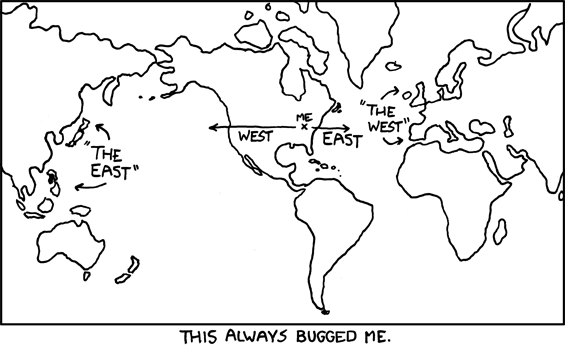
From XKCD:


Yes Americans, any view of the world where you are not in the centre... gosh it just doesn't make sense!

;)

Wednesday, December 03, 2008

Come now

The ANC saying it will rule till Jesus returns? that was pretty dumb. Arrogant. But not blasphemous. I don't think so anyway.

I watched a Journeyman Pictures documentary about Zuma a week or so ago. They interviewed, among others, some people from his home area. And one of them claimed that the Devil was behind all of JZ's probems.

A couple of days ago Ace Magashule, leader of the Free State ANC, claimed that JZ has been suffering in a similar way to Jesus: persecuted, insulted, betrayed (IOL article here).

The ID and the ACDP have taken exception to this, the Magashule comment in particular (here and here).

I'm a Christian, but I don't think any of the above comments were blasphemous. Do you?

I do think then can be manipulative. Definately. A large number of South Africans are Christians, so Biblical methaphor is meaningful to them. And using Biblical metaphor gives the speaker (and organisation!) an air of righteousness. He is using the Bible in his speech, it must be Godly. That sort of thing. People may not think it out exactly like that, but that is what they can come away with. Our great leaders, ordained by God, untouchable.

So yes, I think it can be manipulative. But not blasphemous.

When people made a fuss about it, Magashule responded that he was a Christian and that he wasn't comparing Zuma to Jesus, just the circumstance Zuma is in. Which I think is completely reasonable.

If anything, I think the man who blamed Zuma's troubles on the Devil was a bit more worrying. Especially because his next comments were "the strength of the Zulu nation is being tested through him" and "he was born to lead."

Goodness. I wonder if lots of people think that?